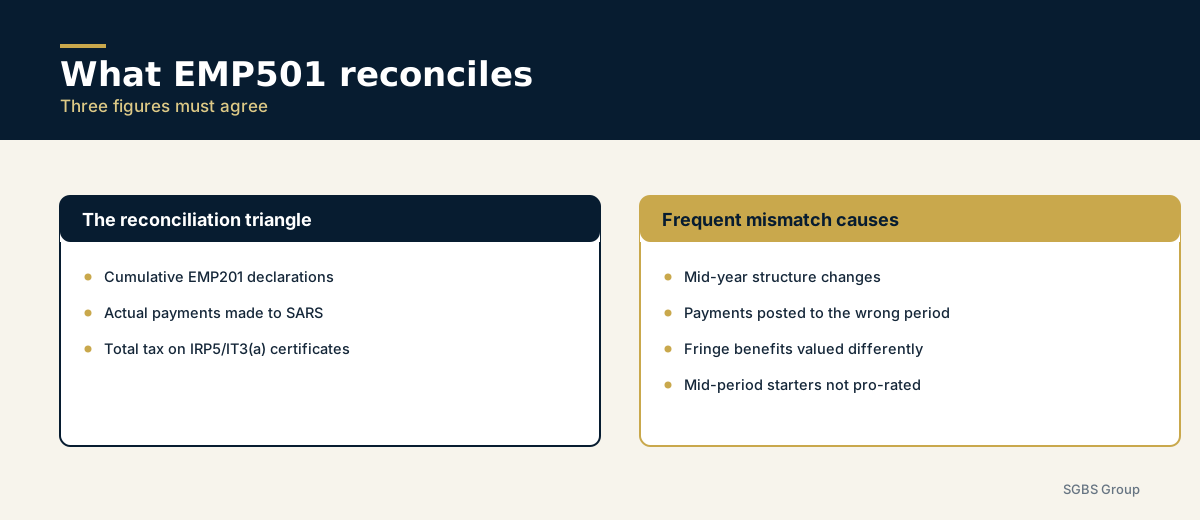
The reconciliation triangle
Three totals must tie. The cumulative EMP201 declarations for the period. The payments actually made to SARS. And the total employees' tax reflected on the IRP5 and IT3(a) certificates generated for that period.
If all three agree, the EMP501 is a confirmation. If any two disagree, it becomes an investigation — and the investigation runs against a submission deadline rather than at whatever pace the evidence allows.
Why it blocks things you would not expect
An unsubmitted EMP501 does not stay contained to payroll. Because compliance status is calculated across every registered tax type, an employer reconciliation outstanding from a prior year renders the business non-compliant regardless of how current its VAT and income tax are.
Companies are blocked for exactly this reason with some regularity, and the diagnosis is slow because nobody is looking at PAYE. The business is chasing a tender or a facility, its VAT is in order, its income tax is filed — and the obstruction is a reconciliation from two years ago that a departed bookkeeper never submitted. The remedy is straightforward once identified; the identification is what takes the time.
Where mismatches come from
Most differences originate in a small number of recurring causes. Mid-year changes to salary structure that were processed in payroll but not reflected consistently in the codes used for certificate generation. Payments allocated to the wrong period or tax type at the point of payment — the same allocation problem that affects the statement of account generally. Fringe benefits and allowances valued one way for the monthly EMP201 and another when certificates are produced, with travel allowances and employer-provided vehicles the most frequent culprits. And starters or leavers mid-period who were not correctly pro-rated.
None of these are complex individually. Their difficulty comes from accumulation: each is trivial to correct in the month it occurs and awkward to unpick once five subsequent months have been processed on top of it.
The commercial cost of the scramble
The obvious cost is professional fees and internal time compressed into the submission window. The larger costs are less visible.
Certificates issued from an unreconciled position create problems for employees, whose own assessments are prepared from those certificates — an error at employer level becomes a correction exercise across the workforce. Penalties apply to late or incorrect submission. And the compliance-status consequence can interrupt trading entirely for a business whose contracts depend on good standing.
For employers in sectors with variable headcount — construction with project-based labour, agriculture with seasonal workers — the pro-rating and mid-period movement problems are structural rather than occasional, and the monthly control matters correspondingly more.
What to check before the submission window opens
The reconciliation itself is only part of the exercise. Before the period closes, three things should be confirmed: that every employee on the payroll has a valid tax number and complete personal particulars, since certificates cannot be issued correctly without them; that terminations have been processed with correct final-period figures rather than left running; and that any employee taxed under a directive has that directive correctly reflected.
These are the items that stall a submission at the point of upload rather than at the point of reconciliation, and they are entirely preventable. A missing tax number discovered during the submission window means chasing an individual who may no longer work there.
The control that prevents it
One reconciliation, performed monthly, removes almost all of this: EMP201 declared, against EMP201 actually paid, against payroll system output for the same month. Checked as each month closes rather than accumulated.
The economics are stark. A mismatch caught in month two is a five-minute correction against records that are still fresh and staff who still remember the change. The same mismatch found in month six during EMP501 preparation is a multi-week reconstruction, conducted under deadline, against a payroll history that has been overwritten several times since.
This is the same principle that governs bank and control-account reconciliation generally, set out under what a controlled month-end close should contain. Payroll is simply the control account that most businesses forget to include.