What replaced the tax clearance certificate
The paper tax clearance certificate is gone. In its place sits the Tax Compliance Status system, in which a taxpayer authorises a third party to verify compliance using an electronic access PIN. The third party enters the taxpayer's reference number and that PIN through eFiling or the SARS Online Query System, and sees the result directly.
The difference is not administrative. A certificate was a snapshot, valid on its face for a period. A PIN is a key to a live record, and the result returned reflects the compliance status at the date and time the PIN is used.
Why that distinction costs businesses money
Consider the sequence. A business obtains a PIN in March and provides it to a lender or a procurement department. In April a VAT return is missed. In May the counterparty re-verifies using the same PIN — for a drawdown condition, a contract renewal, a payment milestone — and sees non-compliant.
Nothing was withdrawn and no notice was issued. The credential simply reported the truth as at the moment of checking. Businesses that think of compliance status as something they obtained in March are frequently surprised by this, and the surprise usually arrives at the worst possible moment in a transaction.
The practical implication is that compliance status has to be managed as a continuous condition rather than an errand. SARS provides My Compliance Profile within the same system, giving a live view of compliance against each requirement, with the specific failures identified. Reviewing it monthly is the control. Discovering a problem when a counterparty checks is not.
What actually gets tested
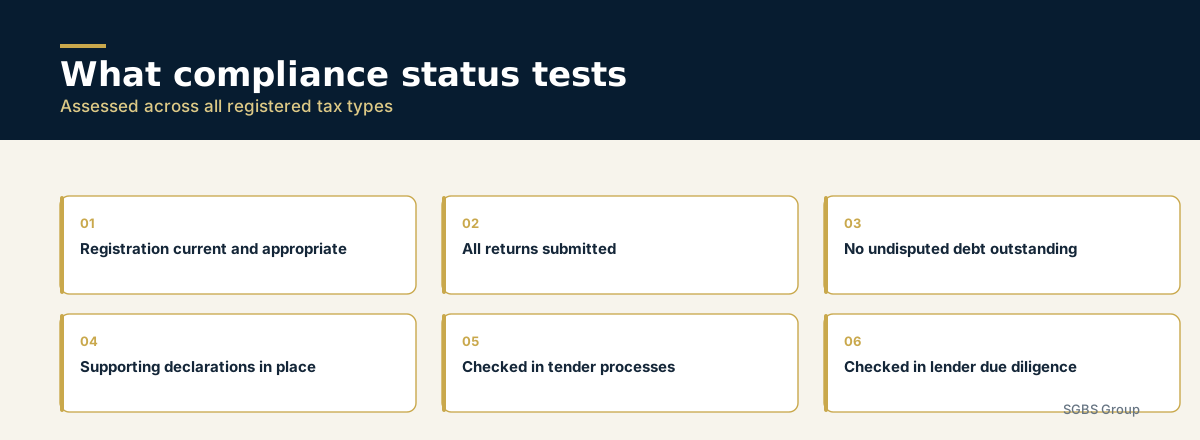
Status considers registration, submission of all returns, payment of any undisputed outstanding debt, and the relevant supporting declarations — assessed across every tax type the business is registered for, not only the one in issue.
That last point causes most of the confusion we encounter. A business can be entirely current on VAT and still show non-compliant because of an EMP501 employer reconciliation that was never submitted in a prior year. Companies are frequently blocked for exactly this reason, and because nobody is looking at PAYE when the VAT position is the live concern, the cause takes time to find.
The commercial exposure
The direct consequence of an outstanding return is a penalty. The commercial consequence has no relationship to that amount.
In sectors where prequalification turns on tax standing, non-compliance is disqualifying regardless of the underlying merit of the business. A construction or mining contracting business bidding public or large private work must demonstrate good standing to be considered at all; a missed return can remove it from a tender it would otherwise have won. A fleet operator whose contract renewal is conditional on compliance faces the same arithmetic. In each case the penalty is measured in hundreds and the lost opportunity in hundreds of thousands.
Lenders apply the same test with less ceremony. Tax standing is treated as a proxy for administrative control generally — the reasoning being that a business which cannot file on time may not be managing much else reliably either. That inference may be unfair in a specific case, but it is applied, and it affects both approval and pricing.
Why catching up is slower than falling behind
Recovery is not symmetric with the failure. Submitting six overdue returns in one month clears the returns, but status calculation looks at the overall position including any resulting debt, and a large assessed liability arising from those submissions can itself keep the business non-compliant even though every return is now filed.
Where that liability cannot be settled immediately, the position needs to be regularised deliberately rather than left open — through a formal arrangement, which is covered under when a tax debt becomes a cash-flow problem. An unaddressed debt keeps the status red; a properly concluded arrangement changes the picture.
Managing it as a control
Three habits prevent almost all of this. Check My Compliance Profile monthly rather than when a counterparty asks. Treat every registered tax type as in scope, not just the active one — dormant PAYE and outstanding EMP501s are the usual culprits. And where a PIN has been issued to a counterparty on a live transaction, understand that the obligation to stay compliant runs for the life of that transaction, not to the date the PIN was generated.
Where the position is already unclear across several tax types and periods, establishing the full picture first is faster than approaching them individually — which is what the Tax Risk Diagnostic™ is built to scope.