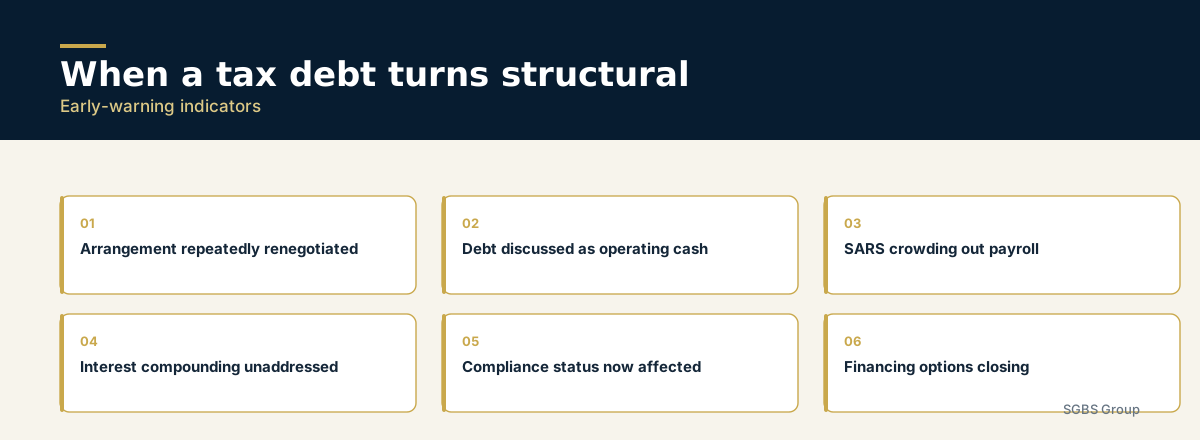
How a manageable debt turns structural
Interest and penalties compound on a SARS balance as they would on any other debt, with one important difference: there is no relationship manager watching it on your behalf and proposing a restructure before it becomes unmanageable. The balance grows quietly until something forces attention.
What makes it structural rather than temporary is when it begins to affect the compliance status that governs tender eligibility and lender confidence. At that point the debt has closed off the financing routes that might have resolved it, and the business is trying to trade out of a position while carrying a constraint on its ability to win the work that would fund the exit.
The three routes, and which applies
South African tax law provides distinct remedies for distinct situations, and applying for the wrong one wastes time the business generally does not have.
Suspension of payment applies where the debt is disputed. Under section 164 of the Tax Administration Act a taxpayer may apply to suspend payment of a disputed amount pending the outcome. This matters because the default position in South African tax is pay now, argue later — lodging an objection does not by itself stop collection. The critical caveat is that interest continues to accrue during the suspension. A taxpayer who wins the dispute owes nothing; one who loses owes the original amount plus the interest that accumulated while it was suspended.
An instalment arrangement applies where the debt is not disputed but cannot be paid immediately. Section 167, read with section 168, permits a deferral or instalment agreement, but only where defined conditions are met — among them that the taxpayer suffers a deficiency of assets or liquidity reasonably certain to be remedied in future, that anticipated income can satisfy the debt, that immediate collection would be uneconomical or harsh, or that adequate security is provided. These are not formalities. An application that does not address them on the evidence tends to be refused.
A compromise applies where the debt cannot realistically be paid in full at all. Under sections 200 to 204 a senior SARS official may authorise writing off a portion of the debt where doing so secures the highest net return for the fiscus. It applies to undisputed liabilities, and the reasoning is commercial rather than sympathetic: SARS is comparing what it would recover through a compromise against what it would recover through liquidation. A proposal that does not make that comparison explicitly and credibly is arguing the wrong case.
The early-warning signs
Certain patterns reliably indicate that a debt has stopped being temporary. A payment arrangement that is repeatedly renegotiated rather than paid down. Tax obligations discussed in the same conversation as operating cash rather than as a separate commitment. Forecasts in which SARS payments visibly compete with payroll or critical suppliers. And VAT collected on sales being used as working capital between collection and payment date — which is the most dangerous of the four, because it feels like liquidity while it is in fact someone else's money temporarily in your account.
Sector patterns
Some business models are structurally more exposed. In construction, where retentions withhold cash and VAT falls due on certified work well before the customer settles, the gap between the tax obligation and the receipt is built into the contract. In agriculture, income arrives in concentrated periods against costs incurred across a whole cycle, so a tax liability falling in the wrong month can be severe for a business that is entirely sound across the year.
In both cases the answer is forecasting the tax liability alongside operational cash rather than treating it as an administrative event — the discipline covered under cash flow and profitability.
Why this is a diagnosis, not a payment problem
A tax debt rarely exists independently of the wider financial position. It is usually a symptom of margin, collection or working-capital pressure that has surfaced through the tax line because that is where the deadline is fixed and the creditor does not negotiate informally.
Treating it purely as a payment problem addresses the symptom and leaves the cause running. The Business Health Index™ scores debt resilience alongside cash and record integrity precisely because these pressures move together — and a business that settles a SARS balance without changing what produced it is generally back in the same position within a year.