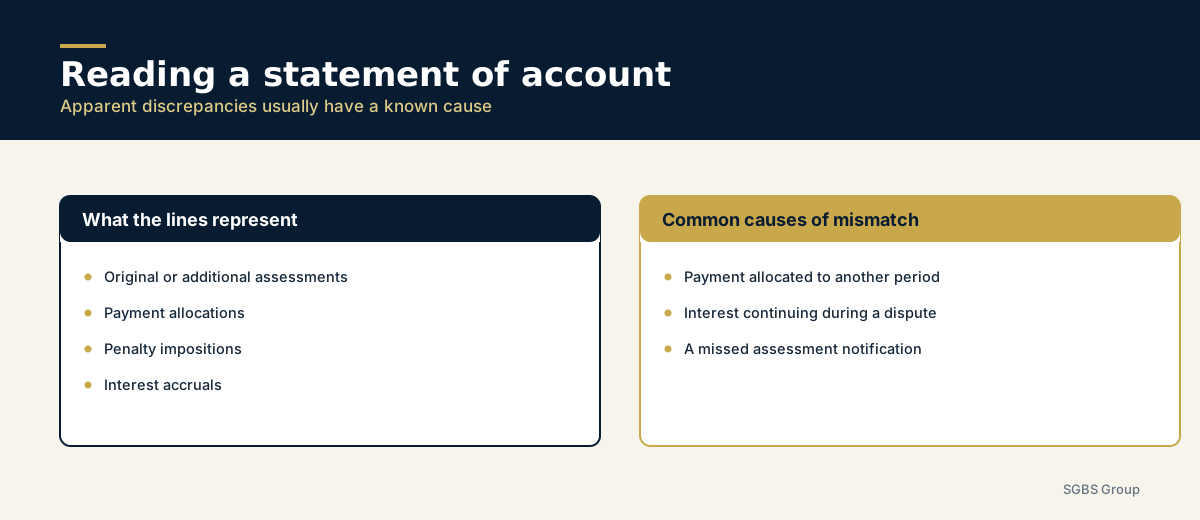
What the lines represent
Each entry reflects one of a small number of events: an assessment, whether original, additional or reduced; an allocation of a payment received; the imposition of a penalty; or an accrual of interest. Read in isolation any line looks arbitrary. Read as a ledger, the sequence explains itself.
The balance at the foot is therefore not a bill. It is the net position after every one of those events has been applied in the order SARS applied them — and that ordering is where most apparent errors actually originate.
Allocation: the most common source of confusion
When a payment reaches SARS it must be allocated against a specific tax type and period. Where the payment reference does not clearly direct it, or where a business makes a single payment intending it to cover several obligations, SARS's allocation may not match what the taxpayer had in mind.
The result is a statement showing an amount outstanding on a period the business believes it settled, and a credit sitting on a period it was not thinking about. No money has gone missing and no calculation is wrong. The payment simply landed somewhere other than intended, and interest continues running on the period that was left short.
This is entirely preventable. Paying each obligation separately, with the correct payment reference number for that specific return and period, removes the ambiguity. Consolidating payments to save administrative effort is the practice that creates the problem.
Where allocation problems concentrate
Certain business structures generate allocation errors as a matter of course rather than by accident. A group operating several registered entities, common in property and real estate where each development or building sits in its own company, multiplies the opportunity for a payment to land against the wrong entity entirely — and a payment allocated to a related company is considerably harder to trace than one allocated to the wrong period within a single account.
Businesses registered for several tax types with different payment cycles face a similar problem from a different direction: VAT bi-monthly, PAYE monthly, provisional tax twice yearly, each with its own reference. A professional services firm with substantial payroll relative to turnover will make many more PAYE payments than VAT payments, and a single misdirected reference in that volume is easy to miss and slow to surface.
Interest during a dispute
A frequent and expensive misunderstanding: lodging an objection does not stop interest accruing on the disputed amount, and it does not by itself suspend the obligation to pay. South African tax operates on a pay now, argue later basis.
Interest continues unless a suspension of payment has been separately applied for and granted under section 164 of the Tax Administration Act — and even then, as covered under tax debt and cash flow, interest continues to accrue during the suspension itself. A taxpayer who disputes an assessment, assumes the clock has stopped, and prevails eighteen months later on part of the amount can still face a materially larger balance than the original assessment.
Reconciling SARS's version against yours
The statement should be reconciled monthly against the business's own tax control account, in exactly the way a bank account is reconciled. Most businesses do not do this. They treat the SARS account as an external record to be consulted when something looks wrong, rather than as a control account requiring agreement each period.
The consequence is that discrepancies are found late, when they have compounded and when the supporting evidence is harder to retrieve. A difference identified in the month it arises is usually a payment allocation traced in minutes. The same difference found two years later, across multiple periods and several intervening assessments, is a reconstruction exercise — the general principle set out under what a controlled month-end close should contain.
Reading discrepancies correctly
Three patterns account for most of what businesses report as SARS errors. A payment reflecting against the wrong period or tax type is almost always an allocation issue rather than a lost payment. Interest accruing on an amount under dispute is usually correct, because no suspension was applied for. And a balance bearing no relationship to internal records generally indicates an assessment the business did not action — often an additional or estimated assessment issued after a return was not filed, sitting unnoticed on eFiling.
That third case matters most, because an unactioned assessment continues to attract interest and eventually becomes final. Genuine SARS calculation errors exist, but they are considerably rarer than the three explanations above, and assuming an error before checking allocation tends to cost time the dispute windows do not allow.
The control that prevents all of this
Treat the SARS account as a control account. Reconcile it every month against your own records. Pay each obligation separately with its own reference. And where an assessment appears that you do not recognise, establish what it is immediately rather than waiting for the balance to explain itself, because the windows for objecting run from the assessment date, not from the date you noticed it.