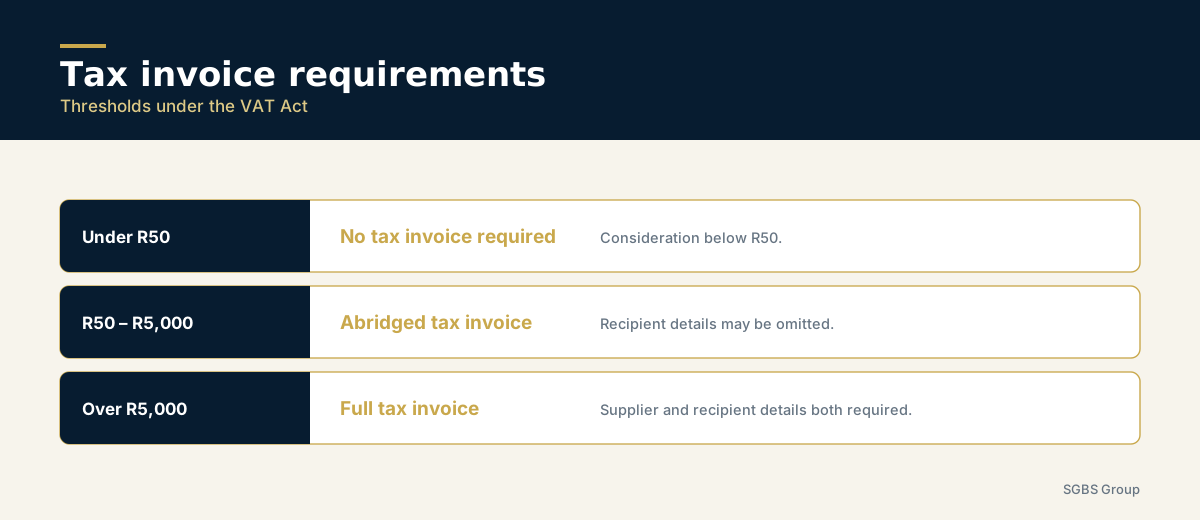
Full and abridged invoices
Section 20 of the Value-Added Tax Act 89 of 1991 sets the requirements, and the threshold that determines which applies is R5,000. Above that consideration, a full tax invoice is required, carrying both the supplier's and the recipient's particulars — name, address and VAT registration number on each side. Between R50 and R5,000 an abridged invoice suffices, which may omit the recipient's details. Below R50 no tax invoice is required at all, though the expense still needs substantiating for income tax purposes.
Whichever applies, certain elements are not optional: the words "tax invoice", the supplier's VAT number, a serial number, the date, a description of what was supplied, and the VAT either shown separately or the invoice stating that it includes VAT at the applicable rate. A document missing one of these is not a tax invoice, whatever it is titled.
Why legitimate transactions lose their claims
This is the part businesses find hardest to accept. The transaction was real. The stock arrived, the service was rendered, the money moved. And the claim still fails — because the deduction is not evidenced by the transaction, it is evidenced by the document.
The commonest defects are mundane. A supplier's VAT number missing or transposed. An invoice addressed to a trading name rather than the registered entity. A pro-forma invoice or a statement filed as though it were a tax invoice. A delivery note treated as proof of supply. None of these are exotic, and all of them are typically discovered months later, when a verification letter asks for the underlying documents and someone opens the file for the first time.
The commercial arithmetic
It is worth framing the exposure in cash terms rather than compliance terms, because the compliance framing consistently understates it.
A business claiming R80,000 of input VAT in a period, where 5% of invoices carry a fatal defect, is carrying a R4,000 exposure in that period alone. Repeat that across a two-year review window and the disallowance is meaningful before penalties and interest are added. The margin implication is direct: disallowed input VAT is not a timing difference that reverses later, it is a permanent cost absorbed against profit.
The exposure concentrates where invoice discipline is weakest, which is rarely the routine payables run. It is the large one-off purchase, the deposit paid against a pro-forma, the subcontractor invoice accepted informally under site pressure. Sectors operating with dispersed purchasing — construction buying materials to site, transport fuelling and repairing on route — carry the highest structural risk, because the document is created away from the person who understands what it must contain.
Beyond the invoice itself
SARS increasingly looks past the invoice to the surrounding evidence chain: proof that the supply was actually received, proof of payment, and a reconciliation tying the invoice to both. An invoice that is technically perfect but sits in isolation, with no corresponding delivery evidence or payment trail, invites the question of whether the supply occurred at all.
Retention compounds this. Tax records must generally be kept for five years, but company accounting records fall under a seven-year obligation, and the longer period governs where both apply — a distinction covered in full under missing source documents and audit exposure. Retention alone is not sufficient in any event: a document that cannot be located within a reasonable period functions, under scrutiny, as though it were never retained.
The abridged-invoice trap
The R5,000 threshold creates a specific failure that recurs often enough to be worth naming. A supplier issues an abridged invoice — omitting the recipient's details, as it is entitled to do below R5,000 — and the amount subsequently proves to be above the threshold once VAT is added, or once several deliveries are consolidated onto one document.
The document is then, on its face, a full tax invoice that is missing mandatory recipient particulars, and the claim on it is vulnerable. This surfaces most often where purchasing is decentralised and the person accepting the document has no view of the threshold, or where a supplier's system defaults to abridged format regardless of value.
The control is unglamorous but effective: any document above R5,000 is checked for the recipient's registered name, address and VAT number at the point it enters the system, and returned to the supplier immediately if it is not there. Immediately matters — a correction requested in the same week is routine, while one requested eighteen months later during a verification is an imposition the supplier may simply decline.
Fixing a defective invoice
Correct it before the return is filed, not after SARS queries it. Once a verification is open, the deadline pressure sits with you and your negotiating position with the supplier has evaporated — you are now asking a third party for a favour on your timetable rather than theirs.
The practical control is a short checklist applied at the point of capture rather than at year-end: does the document say "tax invoice", does it carry the supplier's VAT number, is our registered entity name correct, is the VAT separately stated, and is it above or below R5,000. That takes seconds per invoice at capture and hours per invoice to reconstruct two years later.