What the letter actually is
SARS issues a verification when something in a submitted return does not reconcile against data it already holds — third-party bank data, invoices declared by other taxpayers, or your own prior submissions. It is, in SARS's own framing, a face-value check of what was declared. The request is made under section 46(1) of the Tax Administration Act 28 of 2011, which gives SARS the power to require a taxpayer to submit relevant material required for the administration of a tax Act.
That distinction from an audit is not pedantry, because the timelines are entirely different. A verification is concluded within 21 business days from the date SARS receives all the required material, where the return relates to the current filing period. An audit can run from 30 business days to twelve months or considerably longer, depending on complexity. Businesses that treat a verification as though it were an audit tend to over-engineer the response and miss the window; businesses that treat an audit as a verification tend to under-prepare badly.
The window, and what happens if you miss it
You are generally given 21 business days from the date of the letter to provide the supporting documents and schedules. The onus sits with the taxpayer: under the Act it is for you to demonstrate that what you declared is accurate, not for SARS to disprove it.
Missing that date does not make the matter go away. It converts a documentation request into something with wider consequences, because an unresolved verification feeds into compliance status — and compliance status is checked well beyond SARS itself. A tender process will check it. A lender assessing funding readiness will check it. A business can be entirely solvent and lose a facility over an administrative gap that began as a request for three invoices.
What SARS can, and cannot, ask for
This is the part most businesses do not realise they can push back on. Section 46 carries real limitations. SARS must refer to the material it seeks with reasonable specificity — a general trawl through the accounting records is not what the section contemplates. And the taxpayer is only required to submit relevant material at the place and in the format that is reasonably accessible to them.
In practice this matters when a request is drafted broadly. If a letter asks for "all supporting documentation" for a period, it is legitimate to seek clarification of what specifically is in issue rather than shipping four filing boxes and hoping. A narrower, well-evidenced response closes faster than a comprehensive one, and it does not volunteer material outside the scope of the query.
The commercial cost of a badly handled verification
The direct cost is professional fees and management time. The indirect cost is larger and less visible.
A verification that stalls holds up the compliance status that a tender or a drawdown depends on. For a business in a working-capital-sensitive sector this timing can be more expensive than the disputed tax itself — a construction business waiting on a compliance certificate to invoice a milestone, or a fleet operator whose contract renewal requires proof of good standing, is losing revenue at a rate that has no relationship to the amount SARS queried.
There is a second cost that emerges later. A verification answered with weak evidence, which SARS accepts anyway, leaves the underlying weakness in place. The same defect surfaces again in the next period, usually larger.
What "supporting evidence" means in practice
SARS is not asking for the return again. It wants the primary evidence sitting behind the figure: valid tax invoices, proof of payment, and a reconciliation demonstrating how the declared number was arrived at.
The single most common failure we see is a response assembled purely from accounting-system output — a general ledger extract, a VAT report — with no underlying documents attached. That answers the question "what did you record?" when the question asked was "what can you prove?" Those are not the same question, and only the second one closes a verification.
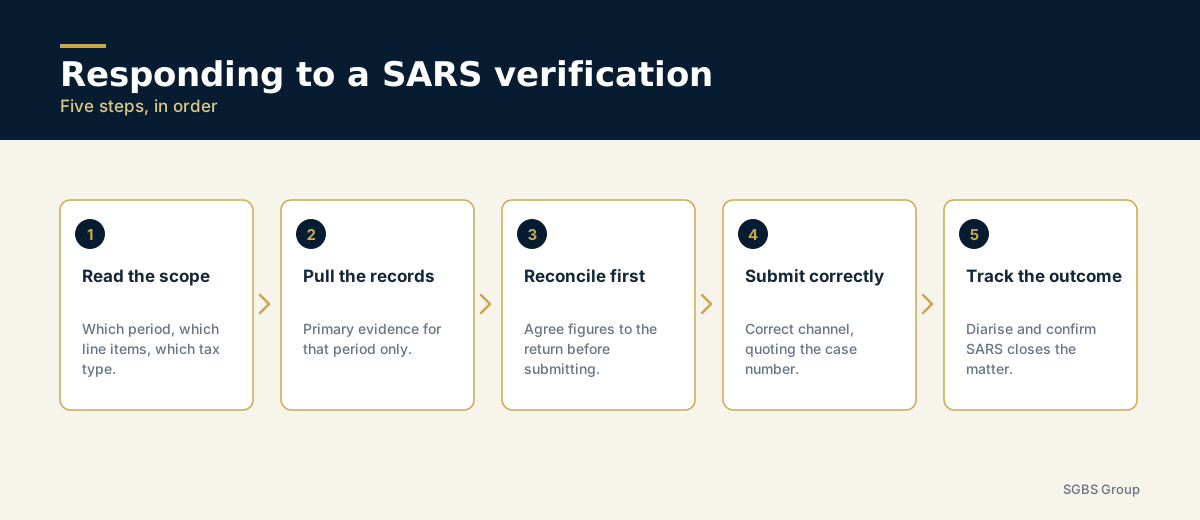
Responding: the order that works
- Read the letter for its precise scope — which tax type, which period, which line items. Do not begin pulling records until this is settled.
- Retrieve primary records for that specific period only. A wider response invites a wider enquiry.
- Reconcile before you submit. If the documents do not agree to the figure declared, you need to know that before SARS does.
- Submit through the correct channel, quoting the case number, in a single complete package rather than in instalments.
- Diarise the outcome. A verification SARS has not concluded still needs tracking — the absence of a response is not resolution.
When a verification is the wrong problem to be solving
Sometimes the letter is not the issue. If the records cannot support the position — gaps in supplier invoices, bank accounts unreconciled for months, no traceable audit trail — then the verification has simply revealed a condition that already existed.
That is a different piece of work, and attempting to answer the letter first usually wastes the window. Where several periods are affected, the honest sequence is to establish the underlying position before responding, which is what reconciling before correcting means in practice. A business unsure which situation it is in can establish that quickly through the Tax Risk Diagnostic™.