Two clocks, running at different speeds
Businesses commonly apply a single retention rule and get it wrong in one direction or the other, because two separate obligations operate concurrently.
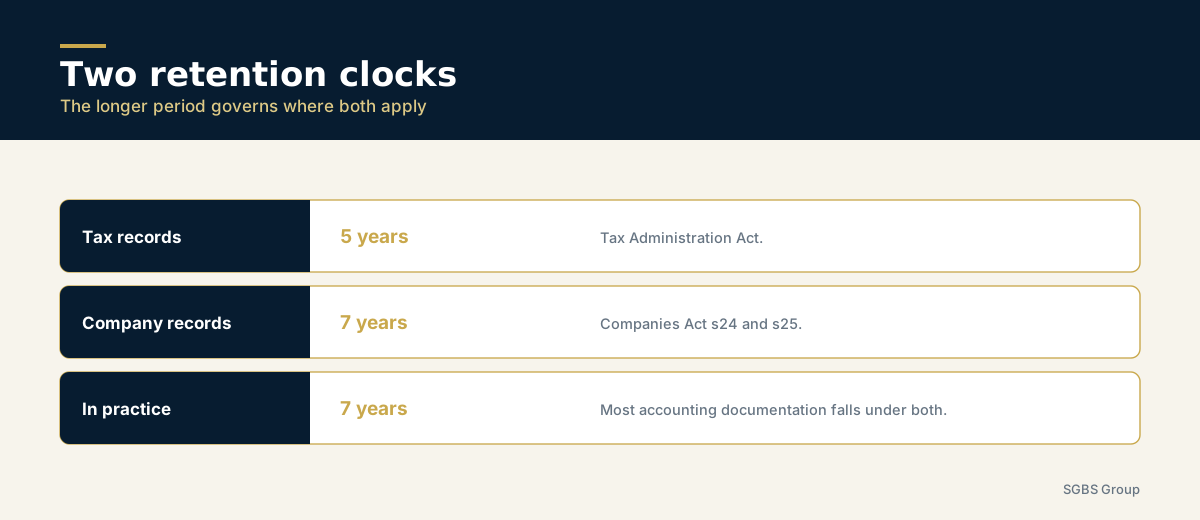
Under section 29 of the Tax Administration Act, records must be kept for five years — and the period runs from the date the relevant return was submitted, not from the end of the tax year. A return filed late therefore carries a retention clock that starts late, which quietly extends the obligation beyond what a calendar-based policy would suggest.
Under sections 24 and 25 of the Companies Act 71 of 2008, company records including accounting records and annual financial statements must be kept for seven years. Where both apply — which for most accounting documentation they do — the longer period governs. A business destroying accounting records at five years is compliant with one Act and in breach of the other.
The clock that does not stop
There is a third condition that almost never appears in retention policies. Section 32 of the Tax Administration Act requires that records relevant to an audit, investigation, objection or appeal be retained until that matter is concluded or the assessment or decision is finalised.
The practical effect is that a live dispute suspends destruction. A business running a routine five-year destruction cycle while an objection is outstanding can destroy the very records that support its own case — and simultaneously breach the retention obligation. Given that a dispute can run well beyond a year through objection, ADR and potentially the Tax Board, this is not a remote scenario.
Any destruction schedule needs a hold mechanism tied to open matters. Without one, the policy that looks disciplined is the one that causes the damage.
Retention is not the same as retrievability
Section 30 of the Tax Administration Act is more specific than businesses expect about form. Records must be kept in their original form, in an orderly fashion and in a safe place, or in an electronic or other form specifically prescribed by the Commissioner or authorised by a senior SARS official.
"In an orderly fashion" is doing real work in that sentence. A archive that technically contains every document but cannot produce a specific invoice from four years ago without a reconstruction exercise does not meet the standard in any practical sense — and under a verification request with a 21-business-day response window, a document that cannot be found within that window functions exactly as though it were never retained.
What a missing document actually costs
Input VAT. Without a valid tax invoice the claim can be disallowed outright, irrespective of whether the transaction occurred — the position set out under VAT invoice evidence requirements.
Deductibility. An expense that cannot be substantiated may be disallowed, increasing taxable income for the period and producing an income tax liability on money that was genuinely spent.
Penalty characterisation. Absent records affect SARS's view of whether reasonable care was taken, which moves the position within the understatement penalty table in section 223(1) of the Tax Administration Act. The same understated amount attracts materially different penalties depending on that assessment.
Assurance scope. A reviewer or auditor unable to obtain sufficient evidence may modify their report, with consequences for lenders and shareholders that persist well beyond the period in question.
Where exposure concentrates
Not evenly. The routine payables run is usually the best-controlled part of the process, because it is repetitive and someone owns it.
The exposure sits in the exceptions: large one-off purchases, contracts supporting unusual transactions, deposits paid against pro-forma invoices, and anything procured away from the finance function. Sectors with dispersed purchasing carry this structurally — construction buying materials directly to site, fleet and transport fuelling and repairing on route — because the document is created by someone who does not know what it needs to contain and has no immediate reason to care.
These are also, predictably, the highest-value transactions, so the exposure is concentrated precisely where the amounts are largest.
Designing to the binding constraint
Three principles follow from the above, and together they resolve most of it.
Retain to seven years rather than five, because the longer obligation governs and the cost of storage is trivial against the cost of a disallowance. Suspend destruction on any open matter, with a documented hold rather than an informal understanding. And design for retrieval by period and counterparty rather than merely for storage, since the legal standard is orderly retention and the practical standard is production within a response window.
The system that supports this is covered under designing approval and document-retention systems for SMEs, where the retention design and the approval matrix are usually built together.