When deregistration applies
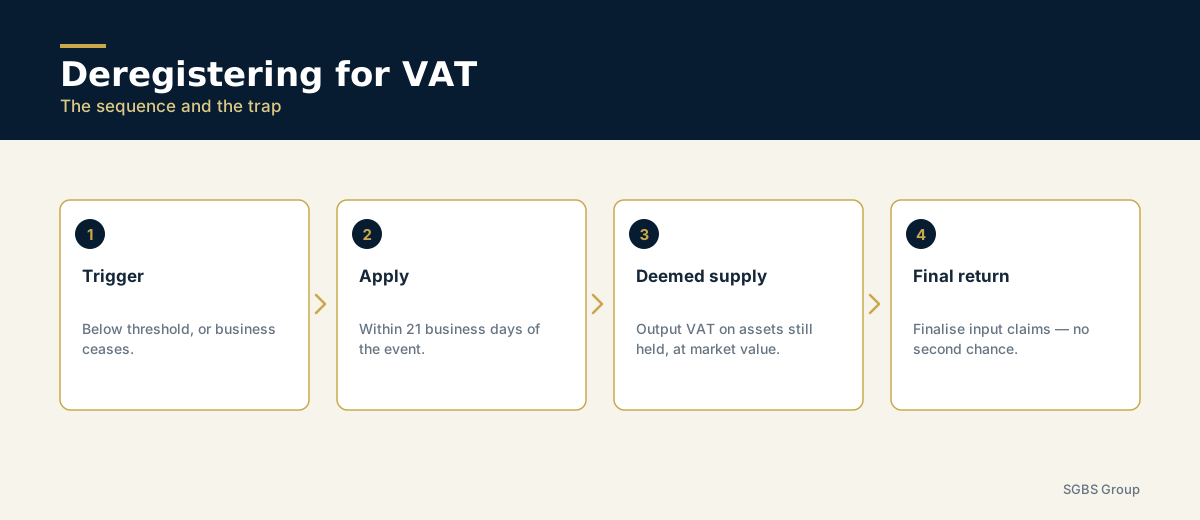
Cancellation of registration is governed by section 24 of the Value-Added Tax Act. It becomes compulsory where taxable supplies fall below the compulsory-registration threshold and are expected to remain there, or where the enterprise ceases entirely. Application is required within 21 business days of the triggering event, mirroring the registration deadline.
The threshold reference point has changed. Following the 2026 Budget the compulsory threshold rose to R2.3 million from 1 April 2026, so the level below which deregistration becomes available has moved with it — the position set out under registration versus voluntary registration. A business that was compulsorily registered at R1.4 million now has a choice it did not have before, which makes deregistration a live question for a much larger population of vendors than previously.
The deemed supply, and why it catches people
On deregistration the vendor is treated as having made a taxable supply of the assets still on hand at that date — plant, equipment, vehicles, trading stock — at market value, with output VAT payable on that deemed value.
Nothing has been sold. No cash has come in. But the liability is real and payable, and it arises precisely because the input VAT on those assets was recovered while the business was a vendor. The deemed supply is the mechanism that reverses that recovery when the assets leave the VAT system.
The consequence is a liability with no matching receipt, at the exact moment a business is winding down or contracting and least able to fund it. A transport operator deregistering while still holding vehicles, or a construction business holding plant, can face a substantial charge on assets it intends to keep using. This needs to be modelled before the application is made, not discovered on the final return.
The final return
A final VAT201 covering the period to the deregistration date is required, and it is the last opportunity to finalise input claims. There is no mechanism to claim input VAT relating to the registered period once deregistration has been processed.
In practice this means the final return deserves more care than any routine one. Outstanding supplier invoices should be collected and processed, claims that were deferred should be brought in, and the deemed supply calculation should be prepared on a defensible valuation rather than an estimate. A business that treats the final return as a formality typically leaves recoverable input VAT behind permanently.
The registrations businesses forget
This is the most common and most damaging oversight. A business ceasing operations deregisters for VAT — the tax it thinks about most — and leaves PAYE, income tax, and its CIPC obligations open.
Those registrations continue to generate filing obligations against an entity that has stopped trading. Returns fall due and are not submitted. Penalties accumulate. And because compliance status is assessed across every registered tax type, the directors of a business they consider closed can find themselves associated with a persistently non-compliant entity years later — often surfacing when one of them attempts something entirely unrelated that requires good standing.
Each registration requires its own closure process. Ceasing to trade closes nothing automatically.
Sequencing a clean exit
The order matters. Establish the asset position and quantify the deemed supply before applying, so the liability is funded rather than discovered. Collect and process outstanding input claims before the final return, because that window does not reopen. Submit the final VAT201 with the deemed supply properly calculated and supported. Then close every other registration deliberately — PAYE, UIF, SDL, income tax and the CIPC position — confirming each rather than assuming.
Where the business is ceasing rather than merely falling below the threshold, that sequence usually needs to run alongside the wider wind-down, and the tax position should be settled before assets are distributed. Assets released to shareholders ahead of a known deemed-supply liability create a problem that is considerably harder to resolve afterwards.