What changed, and why it matters more than it appears
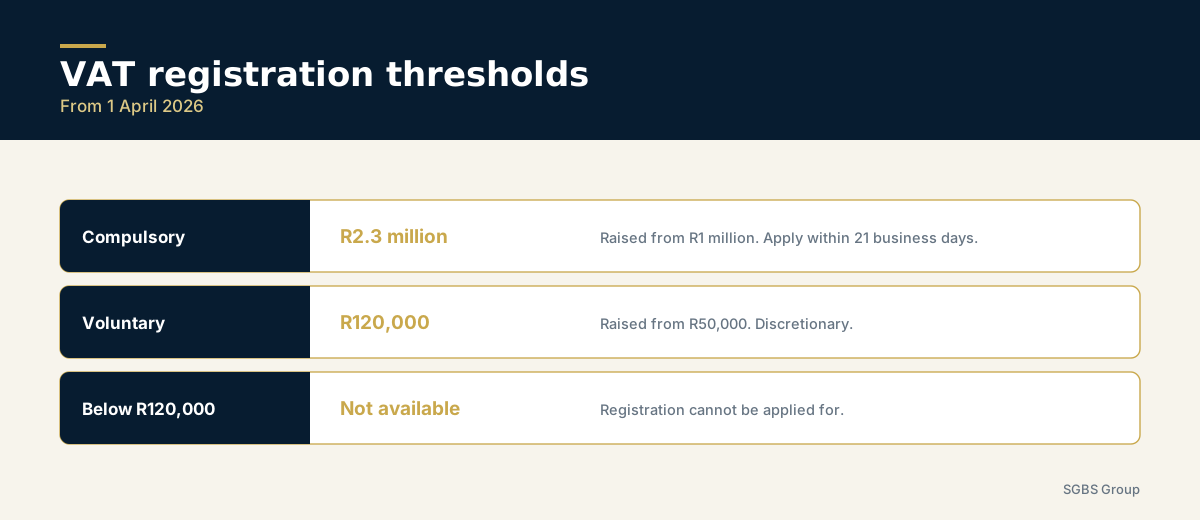
Delivering the 2026 Budget on 25 February, the Minister of Finance, Enoch Godongwana, announced that the compulsory VAT registration threshold would rise from R1 million to R2.3 million, with the voluntary threshold moving from R50,000 to R120,000. Both took effect on 1 April 2026.
The significant fact is not the number. It is that the number had not moved since 2009. For sixteen years a threshold set against 2009 prices drew progressively smaller businesses into the VAT net as the rand depreciated around it — a business turning over R1 million in 2026 is, in real terms, a materially smaller operation than one turning over R1 million in 2009. Commentary around the Budget described the old ceiling as having functioned as a tax on growth, and the mechanism justifies the description: businesses crossed a line drawn for a different economy and inherited a compliance burden calibrated for a larger enterprise.
The immediate consequence is that a business turning over R1.4 million, which until March was a compulsory vendor with no discretion, is now a voluntary one holding a decision it did not previously have.
The commercial question this creates
Deregistration is not automatic. A business already registered remains a vendor, with every obligation that carries, until it applies to deregister and SARS processes that application. Nothing lapses on its own.
The case for staying registered rests on input VAT recovery. A vendor reclaims VAT on its costs; a non-vendor absorbs it. For a business with heavy VAT-bearing inputs — plant, vehicles, stock, professional fees — that recovery is a real and recurring cash benefit, and surrendering it to save administrative effort is usually a poor trade.
The case for deregistering rests on price and administration. Where customers are end consumers who cannot reclaim VAT, the 15% sits inside the price as a competitive disadvantage against unregistered rivals. Where customers are themselves registered businesses, it is neutral — they reclaim it — and the disadvantage disappears. This single question, who the customer is, decides the matter more often than any other.
Sector context
The decision is not sector-neutral, and two industries illustrate the poles.
In fleet and transport, input VAT is substantial and continuous — vehicles, fuel, tyres, maintenance, insurance — and customers are predominantly registered businesses who reclaim without friction. Remaining registered is usually correct here well below R2.3 million, and voluntary registration is often worth taking up early.
In retail and commerce selling to the public, the calculus inverts. The customer cannot reclaim, so VAT is a straight 15% on the shelf price against unregistered competitors, while input recovery on stock only partly offsets it. For a retailer between R1 million and R2.3 million, deregistration now deserves genuine analysis rather than assumption.
Professional services sit between: low input VAT, because the principal cost is people and salaries carry none, but predominantly business customers, so the pricing objection largely falls away.
The mechanics, and where businesses get caught
Registration must be applied for within 21 business days of exceeding, or reasonably expecting to exceed, the threshold. The second half of that phrase does the work and is routinely overlooked. The obligation is triggered by reasonable expectation, not only by the event — a business holding a signed contract that will clearly carry it past R2.3 million is already inside the window before a single invoice under that contract has been raised.
The test runs on a rolling twelve-month basis, not a financial year. This is the most common source of accidental non-compliance. A business reviewing turnover only at year-end can cross the threshold in August, fall back below it by February and never notice, while having been liable to register from September.
Backdating exposure
Where that happens, SARS may register the business retrospectively to the date the threshold was actually crossed rather than the date of application. Output VAT is then calculated from that earlier date, with penalties and interest, regardless of whether VAT was ever charged to customers at the time.
The practical effect is severe and frequently underestimated: the business owes tax on sales it priced as though it were not a vendor, and cannot realistically return to those customers to collect it. The amount comes out of margin. It is among the more damaging exposures precisely because it stays invisible until somebody reconstructs the turnover history — which is generally what a Tax Risk Diagnostic™ is doing at the point it surfaces.
What to do now
- Establish where you actually sit. Calculate taxable supplies on a rolling twelve-month basis, not by financial year, and check monthly rather than annually.
- If you are between R1 million and R2.3 million and registered, model both positions — input VAT recovered against administrative cost and pricing effect — before deciding. Do not deregister by default because the threshold moved.
- If you are approaching R2.3 million, prepare before crossing. Registering mid-scramble produces exactly the invoicing and evidence weaknesses that fail on verification.
- If you suspect you crossed the old threshold historically without registering, quantify the exposure before approaching SARS.