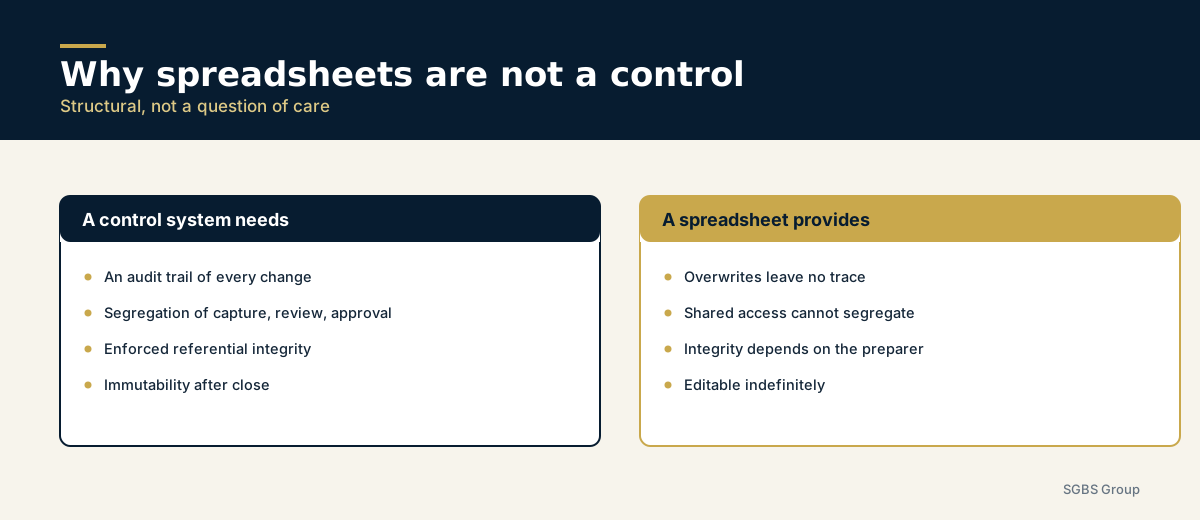
What a control system has to provide
An audit trail. A record of who changed what, when, and what the value was beforehand. A spreadsheet cell overwritten leaves no trace of its previous contents, and no indication that it changed at all.
Segregation of duties. Capture, review and approval performed by different people, with access enforced by the system rather than by agreement. Shared file access cannot enforce this — anyone who can open the file can alter any part of it, including the parts they are meant to be reviewing.
Referential integrity. A transaction that must exist once, must balance, and must reconcile — enforced by the system. In a spreadsheet these properties depend entirely on the preparer maintaining them, and a formula that no longer covers the row added last week fails silently.
Immutability after close. A closed period that cannot change without a documented reason. Any spreadsheet remains editable indefinitely, which means the period lock that defines a controlled close cannot exist in one.
Why careful users do not solve it
These are properties of the tool, not of the operator. A meticulous preparer produces an accurate spreadsheet, and accuracy at a point in time is a genuine achievement — but it is not control.
Control is the assurance that a figure has not changed since it was reviewed, and that assurance cannot be given for a file that anyone can open and edit without trace. The question a reviewer, an auditor or SARS is really asking is not "was this right when you did it?" but "can you demonstrate it is still the same thing?" A spreadsheet cannot answer the second question regardless of how well it answers the first.
What the law expects of the record
This is not purely a best-practice argument. Regulation 25 under the Companies Act requires accounting records to be complete and accurate and to provide an adequate information base to satisfy reporting requirements and permit the proper conduct of an audit or independent review. Section 30 of the Tax Administration Act requires records to be kept in original form in an orderly fashion and in a safe place, or in an electronic form as prescribed.
A reconciliation maintained in an editable file, with no version history and no evidence of review, sits uncomfortably against both. It may well be accurate. What it cannot do is demonstrate that it is.
The intermediate failure that catches most businesses
Few businesses now run their general ledger in a spreadsheet. The common failure is subtler: the ledger sits in a proper system, and the reconciliations that support it live in spreadsheets outside it.
The record is then controlled and its supporting evidence is not. This surfaces the moment somebody asks for the reconciliation that supported a filed figure — exactly what a verification request does. The business produces a spreadsheet that has been edited an unknown number of times since the return was submitted, and cannot demonstrate that it is the version the return was based on.
The same pattern appears with VAT workings, payroll reconciliations, fixed asset registers and stock counts. Each is a control document, and each commonly lives outside the controlled environment.
Where spreadsheets remain the right tool
Modelling, scenario analysis, ad hoc investigation, and the presentation of results. Anywhere the output is an analysis rather than a record of account, a spreadsheet is usually the fastest and most flexible option available, and replacing it with a rigid system is a downgrade.
The failure mode is not using spreadsheets. It is using them as the accounting record, or as the reconciliation that evidences it.
What proportionate improvement looks like
Replacing every spreadsheet is neither realistic nor necessary for most SMEs. Three changes capture most of the benefit.
Move the reconciliations that support filed returns into the accounting system, or attach them to it as locked documents at the point of filing, so the version that supported the return is identifiable. Where a spreadsheet must remain — a stock count, a project WIP calculation — save a dated, read-only copy at each period close and retain it as the evidence, rather than carrying one continuously edited file forward. And restrict edit access on the files that function as controls, rather than treating them as shared working documents.
Sectors that rely most heavily on spreadsheet workings tend to be those whose economics the accounting system was never configured to capture: construction maintaining project WIP and retention schedules outside the ledger, and agriculture tracking production cycles and consignment positions the same way. In both cases these are the calculations that determine the reported result — which is precisely why they should be the first to be brought inside a controlled environment, as covered under finance systems and automation.