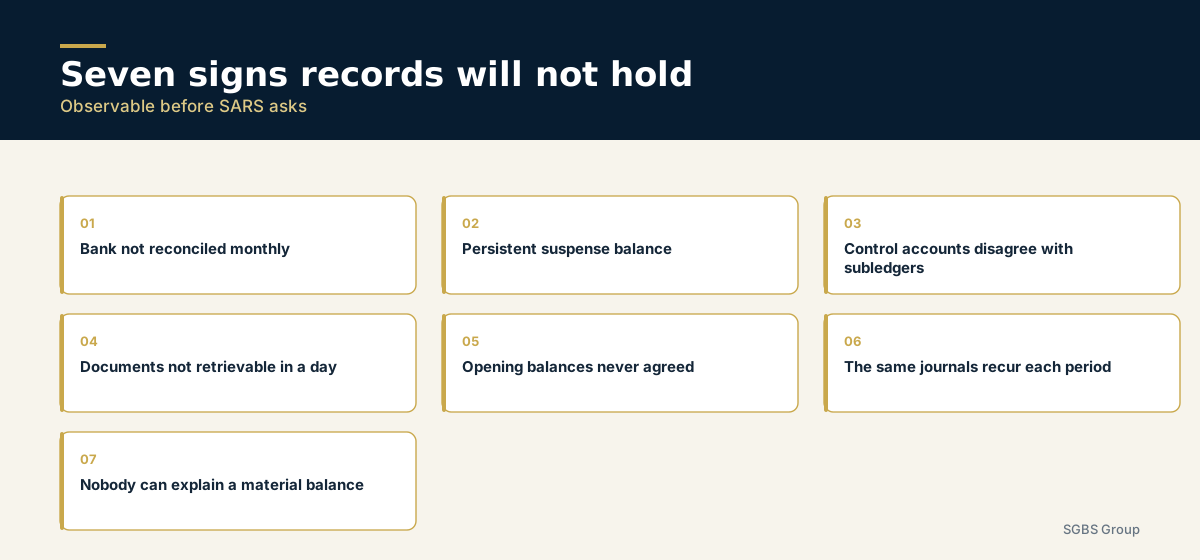
Why these are worth naming
Financial statements can present a plausible position while resting on records that cannot substantiate it. Nothing about a reasonable-looking balance sheet reveals whether the figures can be evidenced, and the difference only emerges under scrutiny — a SARS verification, a lender's due diligence, a buyer's investigation. Each asks the same underlying question: can you prove this?
The seven signs
One: bank accounts are not reconciled monthly. Where reconciliation happens annually or only at year-end, errors have had twelve months to compound and the source of any difference is no longer traceable to a decision anyone remembers. The bank reconciliation is the only independent check most businesses have that their transaction record is complete.
Two: a suspense or unallocated account carries a persistent balance. Suspense is a temporary holding position by definition. A balance that survives period-end means transactions were recorded without being understood, and a balance that survives year-end means nobody has since worked out what they were.
Three: control accounts do not agree to their subledgers. A VAT control account that cannot be tied to the VAT201s actually filed is not a bookkeeping untidiness — it is a quantified difference between what was declared and what the records show, which is precisely the comparison SARS makes.
Four: source documents cannot be produced within a working day. If retrieving a specific invoice from eighteen months ago requires a search rather than a lookup, the filing system will not survive a request for thirty of them within 21 business days.
Five: opening balances were never agreed to the prior year's signed statements. This silently invalidates every period that follows, and it is invisible from within the current year because the current year balances perfectly against an incorrect starting point.
Six: the same adjusting journals recur every period. Recurring corrections mean the underlying process produces a predictable error that nobody has fixed at source. The journal is treating the symptom monthly.
Seven: nobody can explain a material balance without investigating. If the person responsible cannot say what makes up a figure, it cannot be explained to a third party either — and a verification response is exactly that explanation, under time pressure.
What two or more together usually means
Any one of these can be a temporary lapse. Two or more occurring together generally indicates that the position needs reconstruction rather than correction, because they tend to share a cause — a system change handled badly, a departed bookkeeper, a period where nobody reviewed anything.
Attempting to correct individual tax returns on that foundation multiplies the work rather than reducing it, for the reasons set out under why reconciled records must come before tax correction.
The obligation these indicators breach
These are not only practical problems. Section 28 of the Companies Act 71 of 2008, read with Regulation 25, requires accounting records to be complete and accurate and to provide an adequate information base for the company's reporting obligations and for the proper conduct of an audit or independent review.
Several of the seven describe records that plainly do not meet that standard. That matters at director level, because section 29 makes it an offence to be a party to the preparation, approval, dissemination or publication of financial statements knowing that they fail in a material way to comply or are materially false or misleading. The threshold is knowledge — which is precisely what a director acquires by being told that the records cannot support the numbers, and then approving them anyway.
The commercial exposure
The tax consequence is quantifiable and usually the first to surface. The others are larger and less visible.
A business that cannot evidence its numbers cannot raise finance on reasonable terms, because the lender's due diligence asks the same questions SARS does and prices the uncertainty into the rate or declines outright. It cannot be sold without a discount for diligence risk. And in sectors where prequalification depends on tax standing — construction and mining contracting in particular — an unresolved position removes the business from tenders it is otherwise capable of winning.
What to do if several apply
Establish the full position before acting on any individual symptom. That means agreeing opening balances to the last signed statements, reconciling bank and control accounts across every affected period, and quantifying the difference between what was filed and what the records support — before a single return is corrected. A structured self-assessment through the Business Health Index™ scores record integrity as a weighted dimension and is designed to establish that scope quickly.