Why the most recent period is the wrong place to start
Every period inherits its opening balances from the one before it. Reconstructing the current year on top of unverified prior-year balances produces a period that balances internally and is anchored to an unknown — which is worse than an obviously incomplete record, because it looks finished.
The work has to run forward from the last position that can actually be substantiated. Usually that is the most recent signed annual financial statements. Where none exist, or where they cannot be relied upon, it means building an opening position from primary evidence — bank balances, asset registers, loan statements and confirmations — at the earliest affected period.
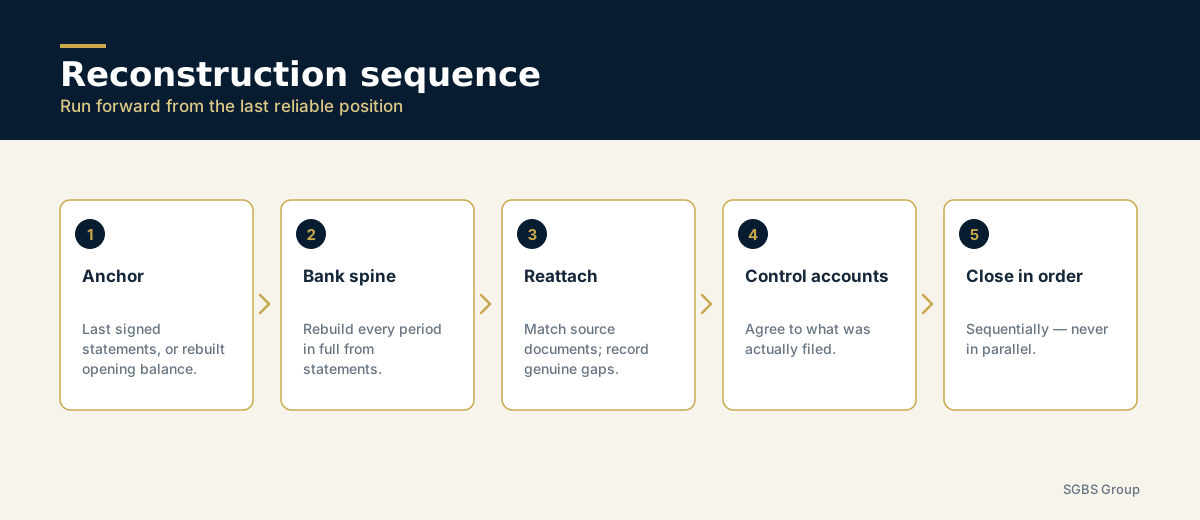
The sequence
- Establish the anchor. The last reliable position, whether signed statements or a rebuilt opening balance supported by third-party evidence.
- Rebuild the bank record in full. Every affected period, from statements, as the transaction spine. Bank data is the one population that is externally verifiable and complete, which is why everything else is reconciled to it rather than the other way round.
- Reattach source documents to bank movements. Identify explicitly what cannot be recovered rather than estimating around it.
- Rebuild control accounts and agree them to what was actually filed. The difference between the reconstructed position and the returns submitted is the quantified tax exposure — and it is the number the whole exercise exists to produce.
- Close each period sequentially. Never in parallel. Each opening balance must be agreed before the next period begins, or the exercise reintroduces the problem it was meant to solve.
Quantify before you remediate
Reconstruction typically reveals the tax position well before it fixes it: undeclared output VAT, disallowed inputs, unfiled periods, PAYE differences.
The full exposure should be quantified across every affected period before any correction is submitted. Correcting periods individually against an incomplete picture creates inconsistencies between them that are harder to explain than the original position, for the reasons set out under why reconciled records must come before tax correction.
There is a second reason, and it is the more consequential one. Remedies that require full and accurate disclosure — the Voluntary Disclosure Programme in particular — are only available before SARS initiates an audit or investigation into the affected period. A business submitting piecemeal corrections without knowing its full position risks triggering exactly the enquiry that closes that door, and the door does not reopen. Where the resulting liability is significant, it becomes a cash-flow question as much as a compliance one, and the remedies there also depend on approaching SARS with a complete and credible position.
What cannot be reconstructed
Some evidence is genuinely unrecoverable. Suppliers have closed, systems have been decommissioned, people have left.
Where that is the case, the gap should be documented as a gap — recorded, quantified and disclosed to advisers — rather than filled with an estimate presented as fact. The distinction is not academic. An acknowledged limitation, supported by an explanation of what was attempted, is defensible. An undisclosed estimate presented as a record is a materially different thing, and section 29 of the Companies Act makes it an offence to be party to financial statements known to be materially false or misleading.
Reconstruction is one of the few exercises where a director is explicitly told the records are unreliable. That knowledge is the threshold the section turns on, which makes how the gaps are treated a governance question rather than only a technical one.
The retention constraint
Reconstruction is frequently constrained by what still exists, and the retention rules cut both ways. Records must be kept five years under section 29 of the Tax Administration Act and seven under the Companies Act, so a business reconstructing a four-year gap should still have most of what it needs — from its own archive, its bank, and its suppliers.
Where reconstruction is triggered by an existing dispute, section 32 requires records relevant to that matter to be retained until it concludes. In practice this means an immediate destruction hold, before the reconstruction begins, so that routine archive cycles do not remove evidence mid-exercise.
Where reconstruction is most often required
Certain events reliably produce it: a bookkeeper departing without handover, a system migration where balances were never agreed across the change, a period of financial distress during which compliance was deprioritised, or a business that grew past the capability of the person maintaining its records.
Sector matters less than transaction complexity, though construction and agriculture are disproportionately represented — in both, the correct period for a transaction is a judgement rather than a date, so records that were merely neglected in other businesses are actively wrong in these.