What each actually delivers
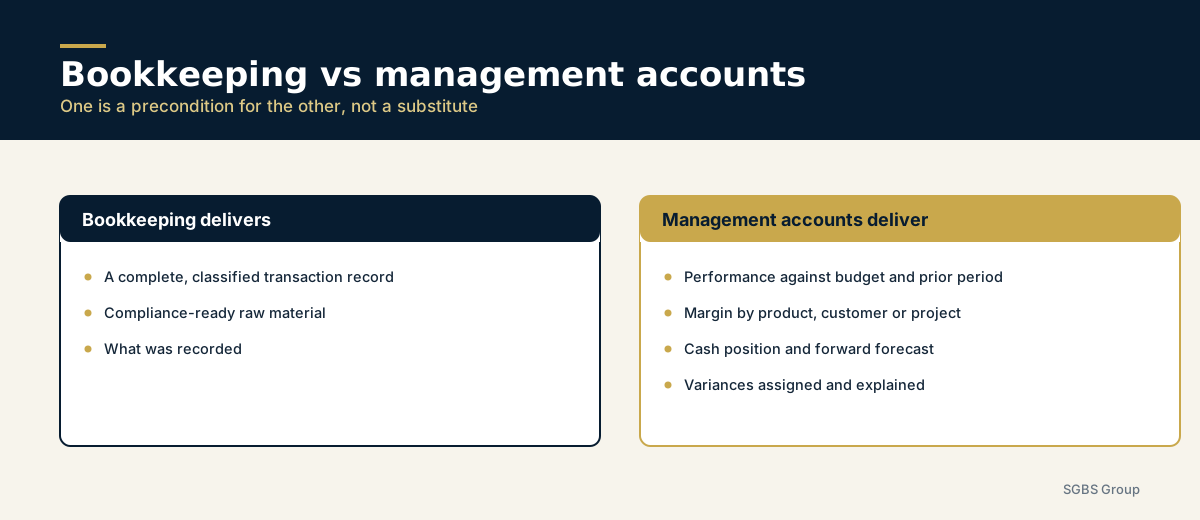
Bookkeeping produces a complete, classified transaction record: every transaction captured, coded and reconciled. That is the raw material, and it is a genuine deliverable — without it nothing else is possible, and a business whose bookkeeping is unreliable has no basis for anything that follows.
Management accounts interpret that record. Performance against budget and prior period, margin by product, customer or project, cash position and forward forecast, and the variances that require a decision. The two are sequential, not alternative — but buying the first does not produce the second, and the language used to sell accounting services frequently blurs the distinction.
What falls into the gap
Four things, consistently.
Variance explanation. A figure moved and nobody is accountable for saying why. The trial balance reports the movement; it does not attribute it, and an unattributed movement cannot be acted on.
Margin visibility below total revenue. Most businesses know their overall gross margin. Far fewer know it by product line, by customer, or by project — which is where the actionable information sits, because the total is an average concealing both the work worth doing more of and the work losing money.
The forward view. A trial balance describes the past. It does not indicate whether the business can meet next quarter's obligations, which is the question that actually determines survival.
Assurance that the position is correct rather than merely complete. Captured and classified is not the same as reconciled and reviewed, as set out under what a controlled month-end close should contain.
Where the gap becomes expensive
It surfaces when a third party asks a question the records were never organised to answer.
A lender testing funding readiness does not want a trial balance. It wants to understand margin sustainability, customer concentration and the assumptions behind a forecast — and a business that can produce figures but not explain them reads as poorly controlled regardless of how sound it actually is. SARS applies the equivalent test from a different angle: a verification asks the business to explain and evidence a declared figure, not merely to produce it.
The cost is not the accounting fee difference. It is the facility declined, the rate priced higher for perceived risk, or the diligence discount applied on a sale.
The practical test
Ask what the gross margin was last month, by main revenue line, and why it moved from the month before.
If answering requires new analysis rather than reference to an existing pack, the business has bookkeeping and not management accounting — whatever the engagement is called and whatever the fee. That test takes thirty seconds and is more reliable than reviewing the service description.
Where the gap is widest by sector
Some models are unusually punished by its absence. In construction, profitability is determined at project level, and a business reporting only company-level results can be comfortably profitable overall while carrying two contracts that are losing money — a fact that only becomes visible when the cash runs out. In fleet and transport, the equivalent unit is the vehicle or the route, and cost-per-kilometre by asset is the measure that distinguishes a fleet that is earning from one that is merely busy.
In healthcare practices, the critical measure is debtor days and rejected claims rather than margin — the revenue is recorded, and whether it is actually collectable is a separate question that bookkeeping alone does not surface.
When a business should make the move
There is no turnover figure at which management accounting becomes necessary, which is why the question is usually answered too late. The trigger is complexity rather than size.
Three changes reliably mark the point. When the owner stops being present for every material decision, because judgement that previously lived in one person's head now has to be made explicit for someone else to act on. When the business carries more than one revenue stream with genuinely different economics, since a blended margin then conceals more than it reveals. And when an external party acquires a legitimate interest in the numbers — a lender, an investor, an incoming shareholder — because their questions are management-accounting questions regardless of what the business was previously producing.
A business that waits for a specific event to force the transition invariably builds the capability under time pressure, for a deadline set by someone else, which is both more expensive and less useful than building it deliberately.
What proportionate looks like
Not every business needs the same pack, and the failure mode in the other direction is real: an elaborate monthly reporting suite that nobody reads is a cost without a benefit.
The proportionate answer is defined by decisions rather than by convention. If a business makes pricing decisions, it needs margin by line. If it carries stock, it needs stock movement and holding measures. If it employs people against billable work, it needs utilisation and recovery. If it services debt, it needs the covenant measures its lender will test. Each report should exist because a decision depends on it, and any report that cannot be tied to a decision should be discontinued rather than produced indefinitely because it always has been.